
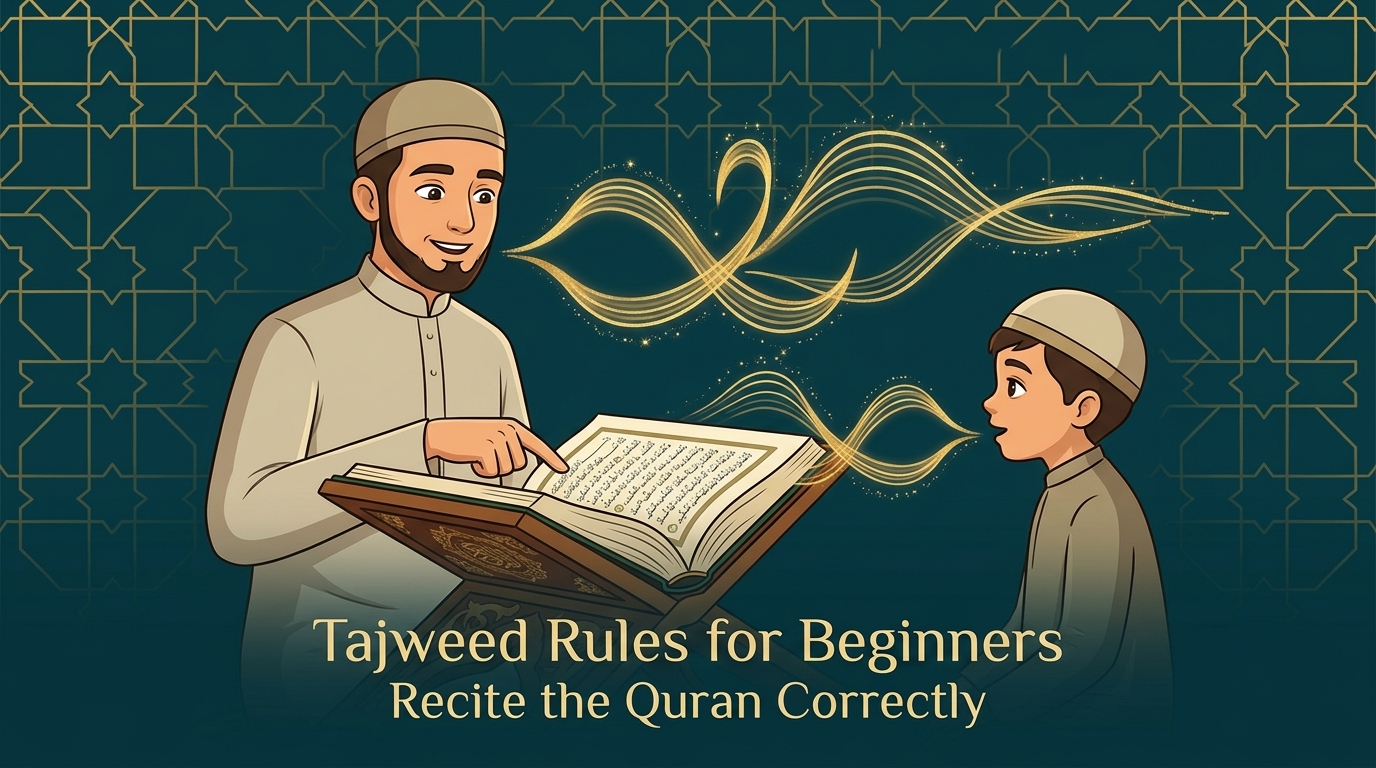
Tajweed (تجويد) literally means "to improve" or "to make excellent." In practice, it's the set of rules that governs how each letter of the Quran should be pronounced — from where in the mouth or throat it comes from, to how long a vowel is stretched, to when a sound is hidden, merged, or echoed. Reciting with Tajweed means reciting the Quran the way it was revealed to the Prophet ﷺ.
Allah commands in the Quran: "…and recite the Quran with measured recitation (tarteel)." (Surah Al-Muzzammil, 73:4)
If Tajweed has always felt like an intimidating wall of Arabic terminology, this guide breaks the essential Tajweed rules for beginners into plain English. You won't master Tajweed from one article — no one does — but you'll finally understand the map.
Why Tajweed Matters (It's Not Just "Sounding Beautiful")
Tajweed isn't decoration. In Arabic, small changes in pronunciation change meaning. Stretch a vowel too long or swap a heavy letter for a light one, and you may be saying a different word entirely. Tajweed protects the meaning of Allah's words on your tongue.
The good news for beginners: scholars distinguish between studying Tajweed theory (a communal obligation) and applying correct pronunciation in recitation (an individual responsibility we grow into). Nobody expects perfection on day one. Tajweed is learned the way it has always been learned — verse by verse, correction by correction, with a teacher.
Rule Group 1: Makharij — Where Every Letter Is Born
Makharij (articulation points) is the foundation of all Tajweed. Every one of the 28 Arabic letters has a precise exit point:
The throat (halq): deep letters like ع, ح, ه, ء, غ, خ — the sounds English speakers find hardest
The tongue (lisan): the largest group, including ق, ك, ج, ض, ل, ن, ر and more
The lips (shafatan): ب, م, و, ف
The nasal passage (khayshum): the home of ghunnah (nasalization)
The empty space of the mouth (jawf): the three long vowels
Why start here? Because if ح and ه sound identical in your recitation, no amount of advanced rules will fix it. A teacher trains your mouth muscles the way a coach trains an athlete — by listening, demonstrating, and correcting in real time.
Rule Group 2: Noon Sakinah and Tanween Rules
The most famous chapter in every Tajweed book. When you meet a noon with sukoon (نْ) or tanween (the double vowels ً ٍ ٌ), the letter that comes after it decides what you do — one of four things:
Izhar (clear pronunciation): Before the 6 throat letters (ء ه ع ح غ خ), pronounce the noon clearly and crisply.
Idgham (merging): Before the letters of يرملون (ي ر م ل و ن), the noon merges into the next letter — with ghunnah for يومن letters, without for ر and ل.
Iqlab (conversion): Before ب, the noon transforms into a soft meem sound with ghunnah.
Ikhfa (hiding): Before the remaining 15 letters, the noon is "hidden" — pronounced from the nose with ghunnah, neither fully clear nor fully merged.
Don't memorize this list tonight. In a structured online Tajweed course, you learn one rule, practice it across dozens of real verses with your teacher, and only then move to the next. That's how the rules move from your notes to your tongue.
Rule Group 3: Madd — The Rules of Stretching
Madd means elongation. The three madd letters (ا و ي) are stretched for specific counts depending on what follows them:
Natural madd (Madd Tabee'i): 2 counts — the default stretch.
Connected & separated madd: 4–5 counts when a hamzah follows the madd letter.
Necessary madd (Madd Lazim): 6 counts — the longest stretch, as in الضَّالِّينَ at the end of Al-Fatiha.
Madd mistakes are among the most common Tajweed mistakes — usually stretching everything the same length, or cutting the 6-count madd short. Since you recite Al-Fatiha in every rak'ah of every prayer, this one rule immediately upgrades your daily salah.
Rule Group 4: Heavy and Light Letters (Tafkheem & Tarqeeq)
Some letters are always pronounced with a "full mouth" (heavy): خ ص ض غ ط ق ظ. Others are always light. And a few — most importantly ر and the lam in Allah's name — switch between heavy and light depending on the vowels around them. This rule group is what gives correct recitation its unmistakable depth and balance.
The 5 Most Common Tajweed Mistakes Beginners Make
Confusing similar letters: س/ص, ت/ط, ه/ح, ذ/ز — pairs that don't exist in English.
Flat, equal madd everywhere — stretching 2-count and 6-count madds identically.
Skipping ghunnah — missing the nasal hum in idgham, ikhfa, and doubled noon/meem.
Reading heavy letters light — ق becoming ك, ط becoming ت.
Learning alone from videos — recorded lessons can't hear you. Mistakes practiced alone get memorized permanently.
How to Learn Tajweed Online (The Realistic Path)
Here's the sequence that works for Quran recitation with Tajweed, whether you're 8 or 58:
Foundation: Solid letter recognition and makharij (via Noorani Qaida if you're a new reader)
One rule group at a time: Noon sakinah → meem sakinah → madd → heavy/light letters
Apply immediately in real verses — rules studied without recitation evaporate
Recite to a certified teacher regularly — this is non-negotiable; Tajweed has been passed teacher-to-student in an unbroken chain since the Prophet ﷺ
Review and refine — even advanced reciters keep polishing
When you learn Tajweed online with a 1-on-1 tutor, every one of those steps happens in a 30-minute class, at your pace, with correction the moment a mistake occurs.
AlQuranClasses' certified Tajweed teachers (male and female, many with Ijazah) take students from complete beginner to confident, correct recitation. Try a free class and hear the difference one session of live correction makes.
👉 Book Your Free Tajweed Trial Class
FAQs: Tajweed for Beginners
Is it haram to read the Quran without Tajweed? Scholars do not consider a sincere beginner sinful for imperfect recitation — the Prophet ﷺ promised double reward for the one who struggles. However, Muslims are responsible for continually improving, especially avoiding errors that change meaning.
How long does it take to learn basic Tajweed? Most students learn the core rule groups in 3–6 months of regular classes, then spend ongoing practice applying them until they become automatic.
Can I learn Tajweed online without knowing Arabic? Yes. Tajweed governs pronunciation, not translation. You can recite with excellent Tajweed while still learning meanings separately.
What is the first Tajweed rule I should learn? Start with makharij (articulation points). Correct letter sounds are the foundation every other rule builds on.
Do adults need a teacher for Tajweed, or are apps enough? Apps are useful for practice, but Tajweed requires a teacher who hears your recitation and corrects it live — pronunciation cannot be self-verified.
Do your teachers hold Ijazah in Tajweed? Many AlQuranClasses tutors hold Ijazah with connected chains of transmission and can prepare advanced students for Ijazah themselves.